Air Cushion Suspension System Analysis
Dynamic modeling and stability analysis of pneumatic air cushion suspension using state-space methods and control theory
Overview
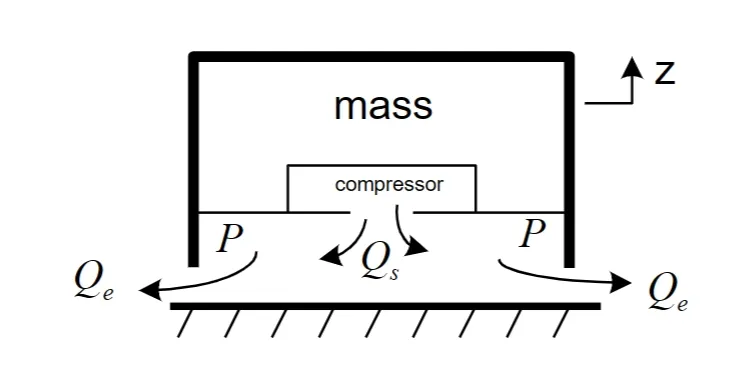
This project develops a comprehensive mathematical model for circular air cushion suspension systems, focusing on dynamic behavior analysis and stability assessment. The study linearizes the pneumatic system around equilibrium conditions and applies modern control theory to evaluate system performance for vibration isolation applications.
Approach
- Linearization Analysis: Developed perturbation equations around equilibrium for mass flow and pressure dynamics
- State-Space Formulation: Constructed 3rd-order system with displacement, velocity, and pressure states
- Stability Assessment: Computed characteristic polynomial and eigenvalue analysis
- Transfer Function Derivation: Used symbolic mathematics for Laplace domain representation
- Numerical Validation: MATLAB simulation comparing multiple solution approaches
System Mathematical Model
The air cushion system is governed by four linearized equations representing force balance, compressor flow, resistance flow, and pressure capacitance:
% Linearized system equations around equilibrium
% (1) Sum of Forces: 4500*Δz̈ - 6.5*ΔP = 0
% (2) Flow Variation (compressor): ΔQs = -0.004*ΔP
% (3) Resistance for flow variation: ΔQe = 0.004*ΔP + 640*Δz
% (4) Capacitance: ΔQs - ΔQe - 6.5*Δż = 1.5×10⁻⁶*ΔṖ

% System parameters
m = 4500;      % Mass (kg)
kP = 6.5;      % Pressure coefficient
Rc = 0.004;    % Compressor resistance
Re = 0.004;    % Exit resistance
Kz = 640;      % Flow-displacement coupling
Cp = 1.5e-6;   % Pressure capacitance
State-Space Representation
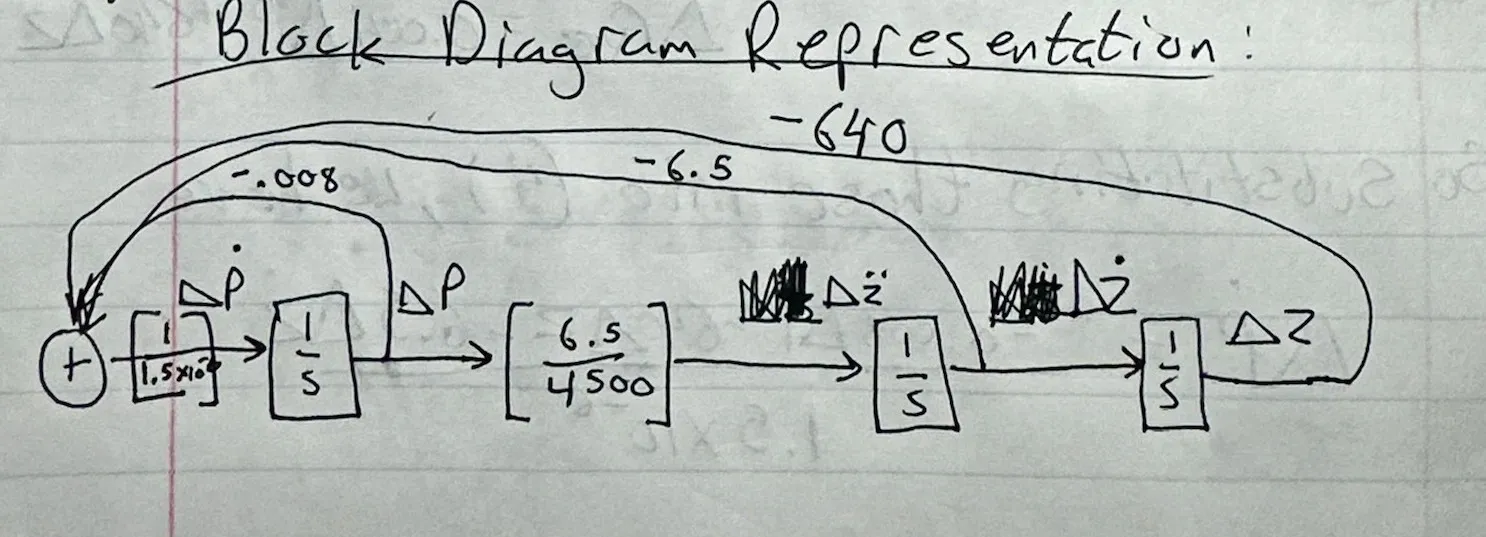
The system was formulated with state variables representing the physical quantities:
- x₁ = Δz (displacement perturbation)
- x₂ = Δż (velocity perturbation)
- x₃ = ΔP (pressure perturbation)
% State-space matrices
A = [0,           1,              0;
     0,           0,              6.5/4500;
     -640/Cp,     -6.5/Cp,        -0.008/Cp];

B = [0; 0; 0];          % No external input for IC response
C = [1/9.8, 0, 0];      % Output: Δz/g (normalized displacement)
D = 0;

% Create state-space system
sys_ss = ss(A, B, C, D);
Stability Analysis
The characteristic polynomial analysis revealed system stability characteristics:
% Characteristic polynomial: s³ + 5333s² + 6264s + 6.16×10⁵ = 0
% Eigenvalues computed:
lambda1 = -5333 + 0j;      % Fast pole
lambda2 = -0.6 + 10.7j;    % Complex conjugate pair
lambda3 = -0.6 - 10.7j;

% System parameters
wn = 10.72;     % Natural frequency (rad/s)
zeta = 0.056;   % Damping ratio (lightly damped)
tau1 = 1.875e-4; % Fast time constant (s)
tau23 = 1.667;   % Slow time constant (s)
Key Finding: The system is absolutely stable with all poles in the left half-plane, indicating effective vibration isolation with light damping characteristics.
Dynamic Response Analysis
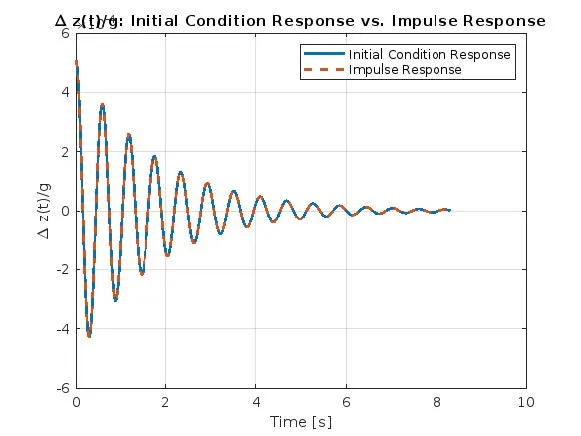
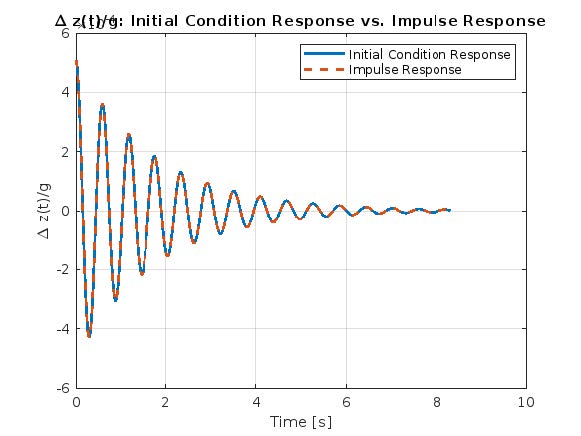
MATLAB simulation validated the theoretical model through multiple approaches:
% Initial condition response
X0 = [0.005; 0; 0];  % 5mm initial displacement
tFinal = 5*1.667;    % 5 time constants
[yIC, tIC] = initial(sys_ss, X0, tFinal);

% Transfer function validation
% Derived symbolic transfer function and compared responses
syms s Z P Qs Qe real;
% [Symbolic solution process...]
sys_tf_scaled = sys_tf / 9.8;
[yImpulse, tImpulse] = impulse(sys_tf_scaled, tIC);

% Plot comparison
figure;
plot(tIC, yIC, 'LineWidth', 2, 'DisplayName', 'Initial Condition Response');
hold on;
plot(tImpulse, yImpulse, '--', 'LineWidth', 2, 'DisplayName', 'Impulse Response');
Results
The comprehensive analysis provided crucial insights for suspension system design:
System Characteristics:
- Stability: Absolutely stable operation with fast pressure dynamics and slower mechanical response
- Damping: Light damping (ζ = 0.056) provides good vibration isolation without excessive settling time
- Natural Frequency: 10.72 rad/s indicates appropriate bandwidth for typical disturbance isolation
Engineering Implications:
- Suitable for precision vibration isolation applications
- Fast pressure response enables effective disturbance rejection
- Low damping characteristics ideal for smooth ride quality
- Mathematical framework enables systematic design optimization
This analysis demonstrates advanced control systems methodology applicable to automotive suspension design, precision instrumentation isolation, and pneumatic actuation systems.